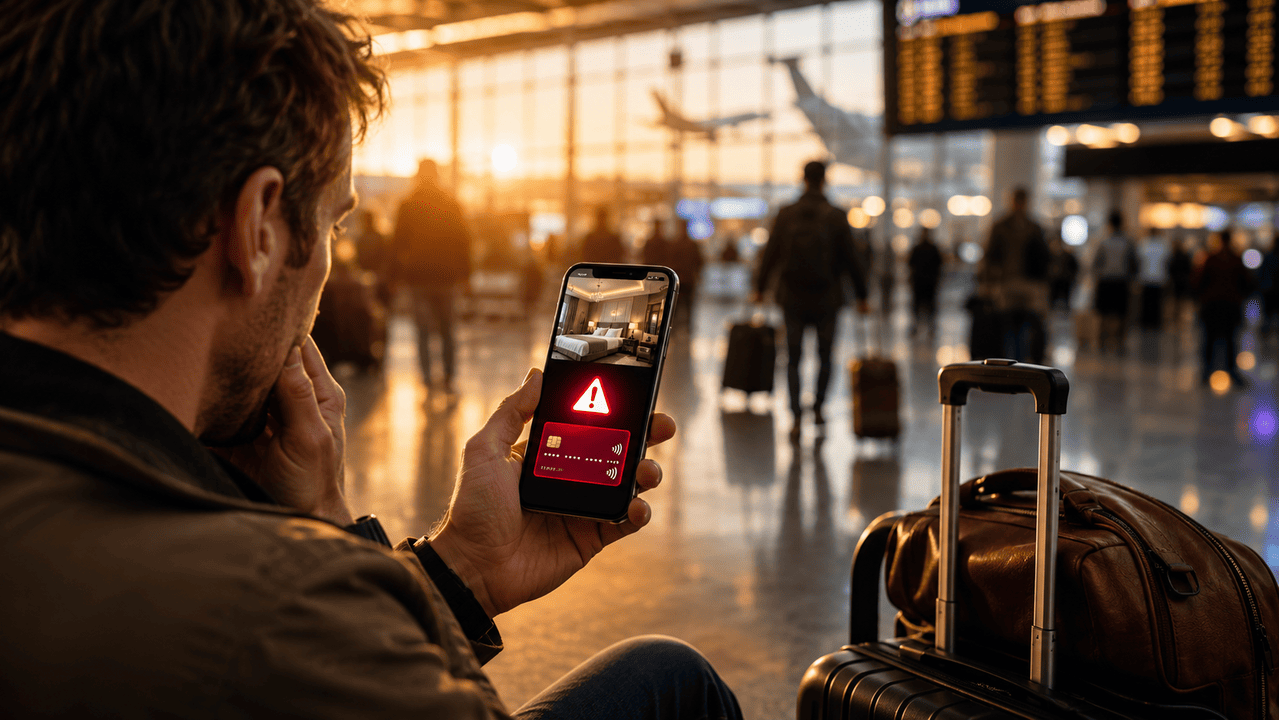
As digital services continue to transform the way we travel, book accommodations, and manage business trips, cybercriminals are increasingly exploiting the trust users place in online booking platforms.
From hotel reservations and flight confirmations to payment notifications and itinerary updates, travel-related communications have become a common part of everyday digital interactions. Unfortunately, they have also become an attractive vehicle for phishing campaigns designed to steal credentials, financial information, and sensitive personal data.
The Growing Appeal of Travel Platforms for Attackers
Cybercriminals are constantly looking for opportunities where users are likely to take immediate action without questioning the legitimacy of a message. Travel platforms provide exactly that environment.
Booking confirmations, payment requests, check-in reminders, reservation changes, and cancellation notices are often time-sensitive communications. When users receive a message related to an upcoming trip, they are naturally inclined to react quickly.
Attackers exploit this sense of urgency by crafting emails and messages that appear to originate from trusted travel services. In many cases, these communications are visually indistinguishable from legitimate notifications, making detection increasingly difficult.
The result is a growing number of phishing attacks specifically designed around travel-related scenarios.
How Travel Phishing Campaigns Typically Work
Unlike highly sophisticated cyberattacks that target technical vulnerabilities, travel phishing campaigns primarily focus on human behavior.
A typical attack may begin with a message claiming that:
- A payment method needs to be verified.
- A reservation is at risk of cancellation.
- Additional information is required to complete a booking.
- A refund or compensation is available.
- An account requires immediate verification.
The user is then directed to a website that closely resembles a legitimate booking platform. Once credentials or payment information are entered, attackers can capture the data and use it for further fraudulent activities.
The effectiveness of these attacks is not necessarily driven by technical complexity. Instead, it stems from a deep understanding of human psychology.
The Role of Social Engineering
Modern phishing attacks rarely rely solely on deception through technology. They are increasingly powered by social engineering techniques designed to manipulate emotions and decision-making processes.
Common tactics include:
Urgency
Messages often suggest that immediate action is required to avoid losing a reservation, missing a payment deadline, or facing service disruption.
Authority
Attackers impersonate trusted brands, customer support teams, travel providers, or booking platforms to create a sense of legitimacy.
Familiarity
Because users frequently interact with travel-related services, these messages appear consistent with expected communication patterns.
Fear of Loss
Threats of cancellation, additional charges, or account restrictions encourage users to act before verifying the authenticity of the request.
These psychological triggers can significantly increase the success rate of phishing campaigns, even among experienced users.
Why Traditional Security Controls Are Not Enough
Many organizations invest heavily in cybersecurity technologies, yet phishing remains one of the most successful attack vectors.
The reason is simple: attackers often target the gap between technical controls and human behavior.
Even when organizations deploy advanced security solutions, a convincing phishing message can still lead users to disclose sensitive information if they are not adequately prepared to recognize suspicious activity.
This highlights the importance of adopting a layered security strategy that combines technological protection with continuous user education.
Key Warning Signs to Look For
While phishing campaigns continue to evolve, several indicators can help users identify suspicious communications:
- Unexpected requests for payment verification.
- Links directing users to unfamiliar domains.
- Login requests that occur outside normal platform workflows.
- Unusual urgency or pressure to act immediately.
- Inconsistencies in sender information or branding.
- Messages containing grammatical errors or unusual language.
Users should always verify requests through official channels before providing credentials or financial information.
Building Cyber Resilience Through Human Risk Management
Organizations increasingly recognize that cybersecurity is not solely a technology challenge. It is also a human challenge.
As phishing campaigns become more targeted and convincing, organizations must ensure that employees understand how modern attacks operate and how to respond appropriately.
Security awareness programs play a critical role in helping individuals recognize social engineering techniques, identify suspicious communications, and develop safer digital habits.
At the same time, organizations must strengthen preventive controls capable of detecting and blocking malicious communications before they reach end users.
A Unified Approach to Defending Against Phishing
Addressing phishing effectively requires protection across multiple layers.
This means securing the communication channels attackers use while also reducing the likelihood that users will fall victim to manipulation techniques.
Cyber Guru and Libraesva have come together to form LibraCyber, bringing together security awareness and human risk management with privacy-first AI-powered email security.
By combining protection for both the email layer and the human layer, organizations can better defend against modern phishing attacks and reduce overall cyber risk.
Learn More
Travel-related phishing campaigns are only one example of how social engineering continues to evolve.
For a detailed analysis of a recent booking-related scam and the techniques attackers use to exploit trusted travel platforms, read the original article published by Cyber Guru.

As said, Libraesva and Cyber Guru have joined forces to become LibraCyber — combining advanced email security with human risk awareness into a single, integrated approach.
Interested in meeting us?
Quick Links
Newsroom Reports Why Libraesva Compare Libraesva SecondSight AI Semantic AI Customer Reviews Pricing InfoRelated Product